
Restrictive budgeting usually backfires. Replacing impulse checkouts with micro-assets uses behavioural friction to protect your savings.
Digital banking apps turn money into on-screen digits, making account balances feel like arcade points or streaming credits. When you tap a phone screen for Grab, Shopee, or a daily coffee run, the transaction completes before your brain registers the financial trade-off.
Trying to stop this through aggressive budgeting rarely works. Restrictive financial diets create internal tension. By the second or third month, that constant sense of deprivation triggers a wave of compensatory impulse spending.
“When leaving surplus cash sitting in your bank account proves difficult, shifting the item you purchase preserves your wealth without fighting the shopping impulse.”
How the Dopamine Swap Rewires Impulse Spending
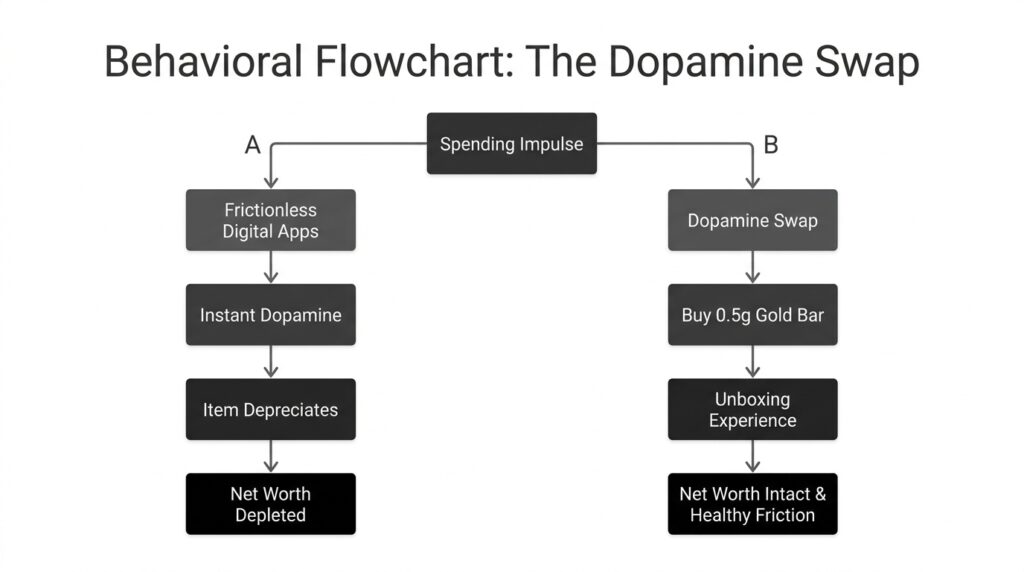
The traditional impulse loop relies on frictionless digital payments to drain liquid cash into depreciating consumer goods. By substituting physical micro-assets into the exact same purchasing sequence, you satisfy the psychological urge to buy while preserving your long-term net worth.
1. The Abstraction of Digital Money
Spending paper currency used to give immediate physical feedback. Handing over banknotes and watching a wallet empty created an unmistakable cognitive signal that wealth had left your possession.
Modern payment applications eliminate that tactile resistance. DuitNow QR codes, linked e-wallets, and one-touch checkouts settle transactions in milliseconds. Because digital digits feel abstract, your brain processes the purchase as an immediate reward without registering the actual reduction in personal savings.
2. Redirecting the Brain Reward Loop
Retail therapy feels rewarding because of predictable neurochemical feedback. Searching for items, tapping checkout, tracking delivery parcels, and unboxing the package each trigger a release of dopamine.
Instead of exhausting willpower to suppress this cycle, you can redirect the reward loop. When an urge strikes to spend RM150 to RM300 on gadgets, clothing, or takeaway deliveries, allocate that exact sum toward a 0.5-gram or 1-gram physical gold bar.
This swap preserves every stage of the psychological experience. You place the order, pay online, and receive a formal transaction receipt. You track the parcel, open the security packaging, and hold a heavy, tangible asset in your hand. While consumer goods lose value the moment their packaging is opened, physical gold retains its intrinsic worth because it represents your own money preserved in solid metal form.
Your brain enjoys the tactile satisfaction of acquiring something new, while your personal capital remains safeguarded.
3. Why Deliberate Transaction Friction Protects Savings
Fintech platforms design digital products to remove any pause between wanting an item and paying for it. That frictionless flow works directly against your long-term savings.
Physical gold reintroduces healthy transaction friction. Liquidating physical gold back into spending cash requires deliberate effort: checking dealer buyback spreads, visiting a branch, or submitting a formal repurchase request. That pause breaks the impulsive reflex loop, giving your brain time to evaluate whether an expense is genuinely worthwhile.
Deliberate transaction friction provides a natural defence mechanism, ensuring casual impulses do not erode your capital.
4. The Silent Capital Transfer
Savings plans frequently collapse when individuals set rigid annual targets that generate continuous mental pressure. A more sustainable strategy treats micro-asset purchases as a steady, quiet capital transfer.
When you move small surplus amounts out of your primary spending account into micro gold bars, you remove easy temptation. Over twelve months, routine purchases of 0.5g or 1g accumulate into a resilient emergency buffer without requiring painful lifestyle sacrifices.
Comparing Saving Dynamics
| Approach | Psychological State | Asset Value Over Time | Transaction Friction | Long-Term Result |
|---|---|---|---|---|
| Strict Budgeting | Deprivation and tension | Stagnant; prone to revenge spending | High mental effort | High failure rate within 60 days |
| Digital Impulse Buying | Short dopamine spike | Depreciates rapidly toward zero | Zero friction (instant QR or tap) | Gradual wealth depletion |
| Dopamine Swap (Gold) | Purchasing habit satisfied | Retains intrinsic wealth value | Healthy friction (requires effort to sell) | Steady capital accumulation |
Key Takeaways
- Work with existing habits. Deprivation creates psychological backlash. Redirect impulse spending into tangible micro-assets rather than attempting to suppress natural purchasing tendencies.
- Employ friction constructively. Excessive liquidity encourages unintended spending. Physical gold introduces natural pauses that safeguard cash reserves.
- Accumulate steadily. Routine purchases of 0.5g or 1g gold bars build meaningful financial resilience without disrupting daily life.
Start Your Gold Savings Journey Today
For readers in Malaysia looking to establish a practical gold accumulation routine, authorized bullion dealers offer accessible entry points. Through the PublicGold Gold Accumulation Program (GAP), you can start accumulating gold backed by physical bullion from as little as RM100, or order minted 0.5g and 1g bars delivered securely to your doorstep via insured Gold-in-Transit (GIT).
To receive personalized guidance on setting up your account with zero advisory fees, connect directly with authorized dealer Nawwar:
👉 Start Your Gold Savings with Authorized Dealer Nawwar
Financial Disclaimer and Author Note
This article is written from the perspective of personal behavioural economics experiments by Ihsan Berahim. It is intended solely for educational and informational purposes and does not constitute licensed financial, investment, or legal advice. Physical gold prices fluctuate according to global market conditions. Evaluate your own risk tolerance and financial situation before committing capital.